Key takeaways:
- General contractors manage construction across several primary categories — including residential, commercial, and industrial industries — focusing on the residential and commercial side, project scopes that range from custom homes and renovations to office build-outs and hospitality fit-outs are common
- The choice between a home builder and a general contractor depends on whether the work is plan-driven and standardized or custom-designed and complex.
- South Florida adds a layer of technical and regulatory specificity — FEMA elevation, NOA-rated assemblies, and the permitting realities of Miami-Dade, Broward, and Palm Beach — that shapes nearly every project.
- Most issues that surface during construction trace back to inadequate pre-construction planning and misaligned expectations, not workmanship.
- A disciplined process and a single point of accountability are the strongest predictors of a project that delivers on schedule, on budget, and to the original design intent.
The scope a general contractor manages is often broader than clients initially expect — and in South Florida, the technical and regulatory context shapes every category of work the GC takes on. Most projects fall along two axes: residential and commercial. Within each, the spectrum runs from a single-room renovation to a multi-million-dollar custom compound or a complex commercial build-out. Understanding what general contractors actually manage — and which firms have genuine depth in which categories — is the foundation of choosing the right partner for the work ahead.
What Projects Do Contractors Manage?
A general contractor manages the full execution of construction from permitted drawings through the certificate of occupancy. That work involves coordinating licensed subcontractors across structural, MEP, roofing, finishes, and specialty trades against a schedule, a budget, and a set of construction documents. The GC is accountable for sequencing, site supervision, inspection coordination, and the performance of every trade on the job.
The work splits along two axes. Commercial projects include office buildings, retail spaces, restaurants, hotels, private clubs, and mixed-use developments — typically phased to minimize tenant or operational disruption and dependent on tight coordination across specialized trades. Residential projects include custom homes, whole-home renovations, additions, and luxury condominium unit build-outs — bespoke by definition, owner-driven, with finishes and systems built to the principal’s standard.
The main types of construction projects with examples include new ground-up construction (a custom waterfront residence, a corporate headquarters), renovations and remodels (a mid-century home modernization, a flagship retail conversion), additions and expansions (a guest house, a commercial office wing), and tenant improvements (a family-office build-out, a chef-driven restaurant fit-out).
In South Florida, every category carries a regulatory layer that shapes constructability from the earliest stages — FEMA elevation requirements, hurricane-impact rated assemblies governed by Miami-Dade Product Approval (NOAs), and the permitting realities of three distinct counties. A capable GC reads those constraints early, builds them into the schedule and budget, and sequences the work accordingly. For more on how innovation and process discipline are reshaping commercial GC delivery in this market, see our article “Recent Trends and Innovations Among Miami Commercial General Contractors.”
Every Phase, Executed at the Same Standard
Core-and-shell, build-out, residential homes, or anything in-between. Blanco Design + Build is ready to start at any stage your project requires, and coordinates with architects, designers, and other key stakeholders.
What Are Some Common Projects That General Contractors Typically Manage?
The most common projects in the high-end residential and commercial South Florida GC market fall into a recognizable set of scopes:
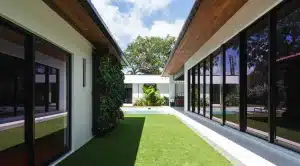
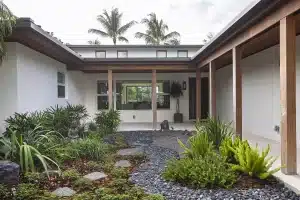
- Custom homes and signature residences. One-of-one, designed and built for a specific site and client. The work integrates climate-responsive design — overhangs, indoor-outdoor integration, impact-rated glazing — with the technical demands of FEMA flood zones, understory design, and concrete block (CMU) construction.
- Whole-home renovations and restorations. From mid-century homes in Coconut Grove or Coral Gables to waterfront properties in Belle Meade and Miami Beach, these projects require careful planning around existing site conditions, current hurricane code, and finish standards that match the original architecture while meeting modern performance requirements.
- High-end commercial fit-outs. Office build-outs for principals, family offices, professional service firms, and showrooms. Corporate HQ’s for financial and professional service firms have produced sustained demand for high-end commercial interior work.
- Restaurant and hospitality build-outs. Among the most technically demanding GC scopes. Commercial kitchen venting, Type I hoods, grease traps, health department compliance, and dining-room finish all coexist on a tight delivery schedule where every delayed opening day is direct revenue loss.
- Luxury condominium unit build-outs. White-box deliveries from developers in towers like 888 Brickell, Villa Miami, and the Residences at Mandarin Oriental require GCs who can execute custom interiors inside a vertical building — navigating freight elevators, building hours, and HOA logistics without losing quality.
- Private club and amenity build-outs. South Florida’s private club pipeline — Shell Bay, Fisher Island Club, the Continuum Club — produces ongoing GC demand for amenity spaces built to a hospitality standard.
Notable examples cluster across the high-end residential corridor — waterfront homes in Belle Meade, contemporary residences in Pinecrest and Coral Gables, ground-up compounds along the Broward and Palm Beach coasts. The top general contractors in Miami share a common posture: they treat each project as singular, manage complexity rather than explain it, and deliver work that matches the design intent without compromise. Blanco builds 2–3 months faster than the regional industry average — a result of in-house coordination across design, engineering, and construction rather than a sequence of handoffs between separate firms.
For a closer look at the design considerations specific to high-end South Florida residences, see “What features should I consider when designing a luxury home in South Florida?“
What's the Difference Between a Home Builder and a General Contractor?
The terms are used interchangeably in casual conversation, but the roles are distinct, and the industries serviced (residential or not) are the biggest difference.
A home builder typically refers to a firm that produces solely new homes at different production levels — production builders working in master-planned communities, semi-custom builders working from a portfolio of base plans, or luxury home builders managing high-end home construction.
A general contractor manages construction against a custom set of drawings prepared by an outside design team. The GC does not typically originate the design — that work belongs to the architect and interior designer. The contractor’s responsibility is to execute those drawings on schedule, on budget, and in full compliance with code, while coordinating every trade on site. A general contractor will also typically coordinate more than residential services, including commercial or industrial work.
For more complex residential or commercial work, a general contractor is the right call. Firms that classify strictly as home builders typically deliver the level of service needed for a production home in a master-planned community.
There is also a third model — design-build — that collapses architect, engineer, and builder into a single firm. Architecture, engineering, permitting, and construction operate under one contract, which closes the coordination gap between design intent and constructability before drawings are finalized. For example, Blanco operates as a fully integrated design-build team and, separately, as a general contractor for clients working with an outside architect. Both modes are first-class offerings. The right choice depends on where the client is in the design process when they engage.
For a deeper read on what to evaluate when selecting a builder, see “What should I look for in a luxury home builder’s portfolio?“
For more on commercial general contracting, see “What is the main role of a general contractor?“
What Are the Most Common Problems That Can Come Up When Working With a General Contractor?
The issues that derail high-end construction projects rarely come from bad workmanship. They come from inadequate pre-construction planning, misaligned expectations, and communication that breaks down under pressure. The four that surface most often:
- Budget overruns. These typically trace back to base-build pricing that excludes permits, landscaping, pools, finish allowances, and the realities of South Florida’s regulatory environment. By the time the all-in number is known, the project is already underway. Our “Honest Numbers” approach addresses this at the engagement stage — realistic, all-in price ranges from the outset rather than a low base figure that balloons through change orders. Look for a general contractor that operates similarly and with transparency.
- Schedule delays. Most often the result of coordination gaps between separate design and construction firms, late material lead times on hurricane-impact glazing or specialty millwork, and permit revisions that surface only after submittal. A GC engaged in pre-construction can resolve constructability issues before the drawings reach the plan reviewer.
- Miscommunication. Between the principal, the design team, the GC, and the trades. Best mitigated through stage-gate review, transparent progress tracking via a platform like BuilderTrend, and direct access to the firm’s leadership rather than an account manager.
- Quality control lapses. Almost always tied to subcontractor performance and the absence of consistent on-site supervision. The mitigation is structural: in-house superintendents, long-term subcontractor relationships, and a punch-list and close-out process that closes loops rather than postponing them.
The strongest predictor of a project that delivers on intent is not the contract — it is the discipline of the process. Clear accountability at each stage-gate, a GC who is either part of the design team or fully integrated with it, and direct communication with the firm’s leadership are the practical instruments of a well-run project.
Need a general contractor that manages complexity before it reaches you?
Schedule a conversation with Blanco Design + Build to discuss your scope, your site, and the right delivery model for the work ahead.